Bathrooms · · 4 min read
Bathroom lighting done right: lit niches, backlit mirrors and toe-kick LEDs
Good bathroom lighting is layered. A few small, well-placed lights do more than one bright fixture.
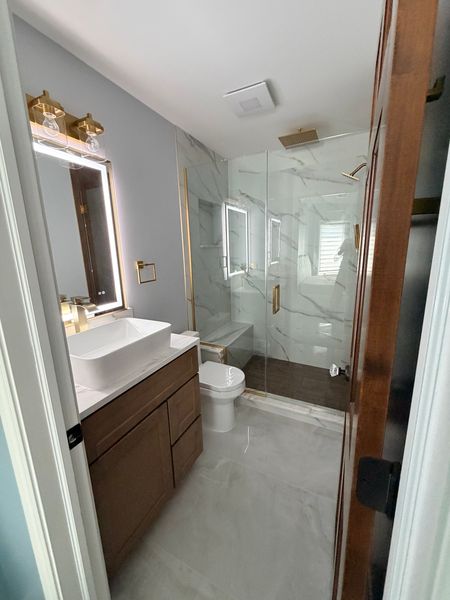
Bathroom lighting is easy to get wrong. A single bright light in the ceiling makes everyone look tired, throws shadows under the eyes and leaves the shower in half-light. A better approach is to use several kinds of light, each with its own job.
The details below are the ones we plan with homeowners. Most of them have to be decided before the walls are closed, so it pays to think about them early.
Light for the face
For shaving, makeup and grooming, the light has to fall evenly on the face. Fixtures above the mirror alone often cast shadows under the chin and eyes.
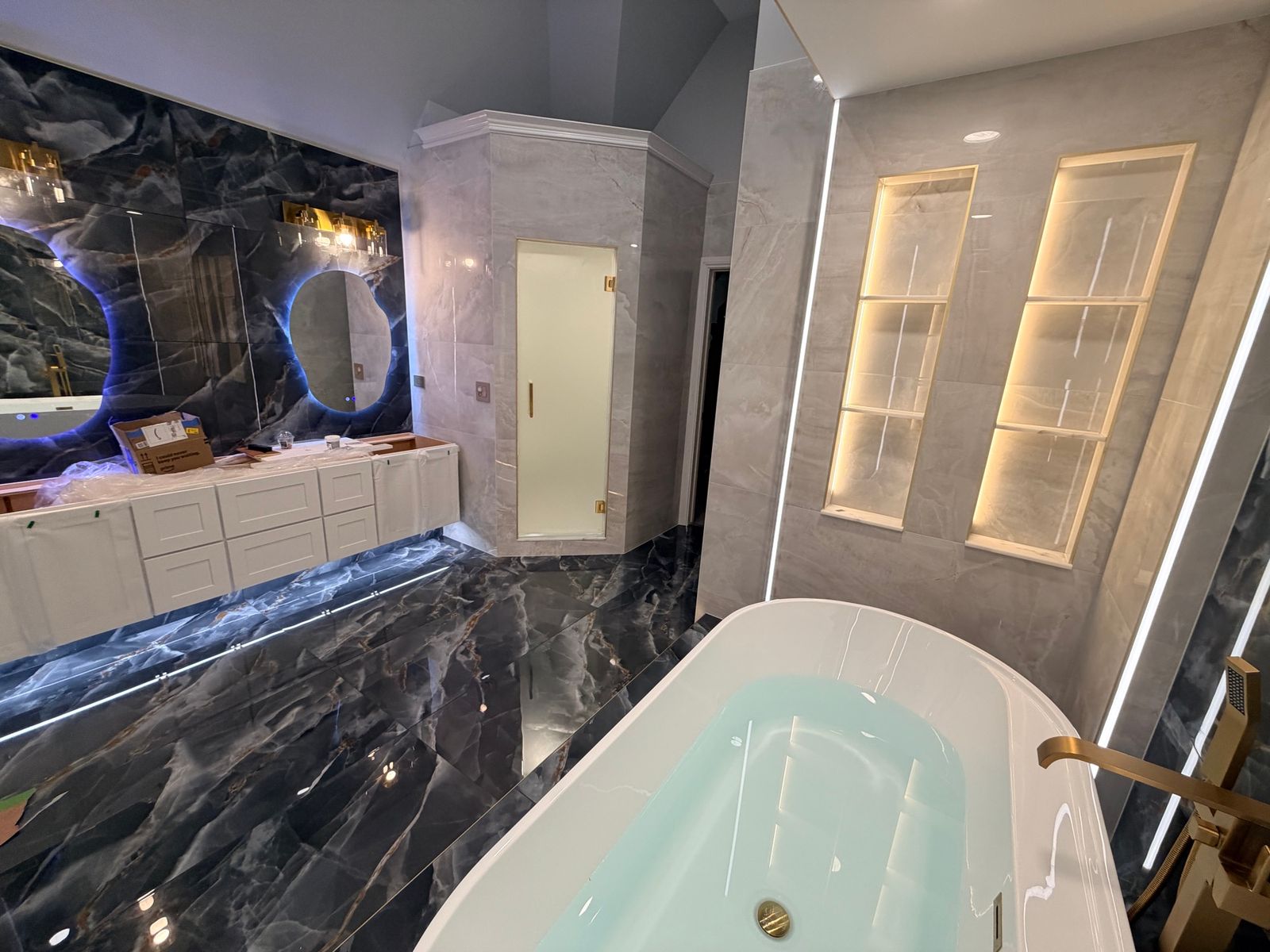
A backlit or edge-lit mirror solves this. The light comes from around the glass and washes the face evenly. Many of these mirrors also have a defogger and dimming, which makes them useful in the morning and gentle at night. In a primary bath we finished, round mirrors with soft light stand over a double vanity, with brass wall lights above.
Light for the shower
A shower needs its own light. A recessed fixture rated for wet locations, placed over the shower, makes it bright enough to see what you are doing and to keep the glass looking clear. Without it, a dark shower makes a bright bathroom feel unfinished.
Lit niches
A niche is a recess in the shower wall or a feature wall. On its own, it holds bottles. With a light inside it, it becomes a glowing detail.
The lights are usually LED strips tucked behind the edge, so the glow comes from the surface and not from a visible bulb. The same trick works for tall wall niches in a primary bath: two lit niches beside a freestanding tub make a calm backdrop at night.
Plan the niche early. The wiring has to reach it, and the framing, waterproofing and tile all have to be built around it.
Toe-kick and floor lights
A thin LED strip under a floating vanity, or along the base of a shower, gives a soft glow at floor level. It lets you find your way at night without turning on the main light, and it makes the vanity look like it floats.
For these, we use strips made for damp areas and place the power supply where it can be reached later for service.
Dimming and color
A few details change how the room feels:
- **Dimmers** let you use bright light in the morning and soft light in the evening.
- **Warm or neutral light** is usually flattering. Very cold light can feel clinical.
- **Matching color across fixtures** matters. A white fixture next to a yellow one looks like a mistake.
- **Separate switches** for the main light, the mirror and the accent lights give you control.
Safety in a wet room
Lights near water have to be made for it. The fixtures in and around a shower must be rated for damp or wet locations, and the electrical work has to follow the rules that apply to your home. Those rules vary by village, so check with your village building department. Where a permit is required for electrical work, OVK coordinates it.
Planning before the walls close
The most common regret we hear is that nobody planned the lights early enough. Once tile is up, adding a niche light or a mirror outlet means opening the wall. When we plan a bathroom we mark each light, outlet and switch on the layout before work begins.
Where the electrician and the tile setter meet
Lighting in a bathroom is one of the places where trades depend on each other. The electrician needs to know where the niche sits before the tile setter closes the wall, and the tile setter needs to know where the light channel sits before cutting the tile around it. We bring them into the same plan, with each fixture marked on the drawing. The result is clean edges, no patches and light sources that line up with the tile joints. It is a small thing, but it is what separates a room that looks designed from a room that looks improvised.
Test before you close
Before any wall is covered, we switch every light on and look at it. A strip that flickers or a driver that hums is far easier to replace while the wall is open.
Talk it through with us
Light changes how a bathroom feels more than almost any other detail. If you would like to plan it properly, see our bathroom remodeling page and request a free estimate. We will go through the room and suggest a lighting plan that suits it.
Questions people ask
Are LED strip lights safe in a bathroom?
Yes, when you use strips and power supplies made for damp or wet areas and install them correctly. We do this as part of the electrical plan.
Can I add a lit niche to an existing shower?
Only if the wall is open. It is easiest during a remodel, when the framing and wiring can be arranged for it.
What color of light is best for a bathroom?
Warm to neutral white is usually the most flattering. We can show you samples in your own room.