Floors and finishing · · 4 min read
Tray ceilings and LED cove lighting: how they work and when they suit
A tray ceiling adds a layer to the room. With a hidden strip of light, it adds a glow at night too.
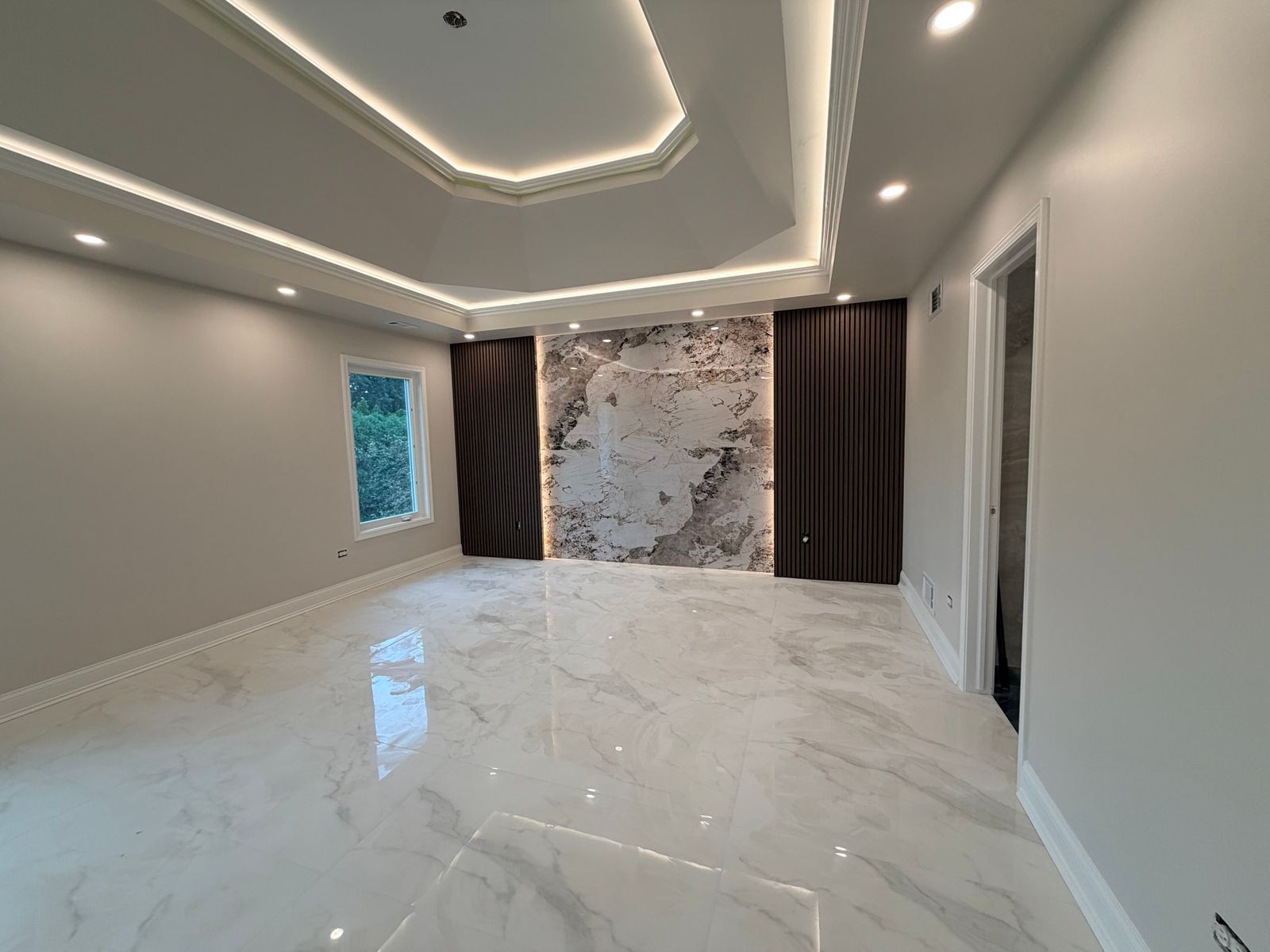
Look up in a well-designed bedroom or living room and you may see a ceiling with a raised center and a soft line of light around its edge. That is a tray ceiling with cove lighting, and it is one of the most effective ways to make a room feel finished.
It is also a feature that has to be planned. Here is how it works.
What a tray ceiling is
A tray ceiling has a flat center that sits higher than the outer edge, like an inverted tray. The step between the two levels is called the tray, and the vertical face is the side. Some trays have a single step; others have two.
Because the center rises, the room feels taller. Because the edge is lower, the ceiling has a frame that gives it definition.
What cove lighting is
Cove lighting is a strip of LED light hidden in the step of the tray, pointing up. The light washes across the higher ceiling and reflects softly into the room. You see the glow, not the source.
In a bedroom we finished, a tray ceiling with LED cove lighting and recessed lights sits above a glossy marble-look floor. The shape of the ceiling and the line of light give the room a calm, upscale feel.
When a room is a good fit
Tray ceilings suit rooms with enough height and a regular shape: primary bedrooms, living rooms and dining rooms. In a very low room, lowering the edge to build the tray can make the space feel smaller.
Before deciding, we look at the ceiling height, the framing above and what runs through it, such as ducts, wires and pipes. Sometimes these limit where the tray can go.
What the work involves
Building a tray ceiling takes several steps.
- **Framing.** The step is framed with wood or metal, which has to be level and square.
- **Wiring.** Power for the LED strips and any recessed lights is run before the ceiling is closed.
- **Drywall.** The framing is covered and finished, with smooth, clean corners and edges.
- **The light channel.** The strip needs a clean, even surface to sit on, and a cover or channel that keeps the glow smooth.
- **Painting.** A matte finish usually hides imperfections in the light better than gloss.
Choosing LED lights
Not all LED strips are the same. A few details matter:
- **Color temperature.** Warm to neutral is more flattering than cold.
- **Dimming.** A dimmer lets you use the strip as a night light or a bright wash.
- **Quality.** Cheap strips can look spotty, with visible dots of light, or change color over time. A good strip gives an even line.
- **Access.** The power supply should be reachable for service, usually through a small access panel or a closet.
Combine with recessed lights
Cove lighting is soft, so most rooms also need task light. Recessed lights placed within the flat center or the outer ring give brightness when needed. Separate switches or a dimmer system let you use them independently.
Think about the walls and floor
A lit ceiling shows everything below it. Paint and wall finishes should be smooth, and a glossy floor will reflect the glow. In the room above, large marble-look tile on the floor does exactly that.
If you are also planning an accent wall, see our post on wood slats, slab tile and paneling.
Cost and timing
What drives cost is the amount of framing, the electrical work, the number of lights, the finish of the drywall and the paint. We explain each in the estimate.
Permits
Framing changes and new electrical work may need a permit. Requirements vary by village, so check with your village building department. Where a permit is required, OVK coordinates it.
Make it fit the room
A tray ceiling should relate to the room beneath it. The inner shape usually follows the walls, and the step is sized so it looks balanced, not like a thin frame or an oversized box. Think about where the bed, the sofa or the dining table will sit, and center the feature on that, not only on the room. Fans and ceiling lights need places too. A tray with a ceiling fan in the middle is possible, but it is a choice about how the room will look, so make it deliberately.
Talk it through with us
If a tray ceiling sounds right for a room in your home, see our interior finishing page, then request a free estimate. We will check the ceiling height and the framing, and show you what is possible.
Questions people ask
Do LED cove lights get hot?
LED strips run cooler than older bulbs, but they still need to be installed with the right power supply and channel.
Can I add a tray ceiling to an existing room?
Often yes, if the framing and height allow it. We check what is above the ceiling first.
How long do LED strips last?
It depends on the quality of the product. We choose good strips and place the power supply where it can be serviced.