Floors and finishing · · 4 min read
Large-format floor tile: why the layers underneath matter
The tile is the part you see. The layers beneath it decide whether it still looks good in a few seasons.
When people choose a floor, they look at the tile: the color, the veining, the finish. Yet most of what makes a tile floor last is out of sight. The layers underneath decide whether large tiles stay flat and crack-free or lift and split.
Here is what goes under a tile floor, and why we do not skip steps.
Why large tile is more demanding
A large tile covers a lot of floor in one piece. If the surface below it is uneven, the tile can rock or hang over a low spot. If the structure moves a little, as wood floors do with the seasons and with weight, a rigid tile cannot flex with it. A small tile has many joints to absorb movement. A large one has few.
That is why preparation matters more, not less, when tile gets bigger.
Layer one: the structure
Under every floor is a subfloor, usually plywood or boards over joists, or a concrete slab. Before tile goes down we check that it is sound, firmly fastened and stiff enough. A bouncy floor is a tile problem waiting to happen, and extra support or an additional layer may be needed.
Layer two: flattening
The surface has to be flat across the whole span of a large tile. We check it with a long straightedge. High spots are ground down, and low spots are filled with a leveling compound. This step is easy to rush, and it is one of the main differences between a floor that looks flat and one that looks wavy in raking light.
Layer three: the membrane
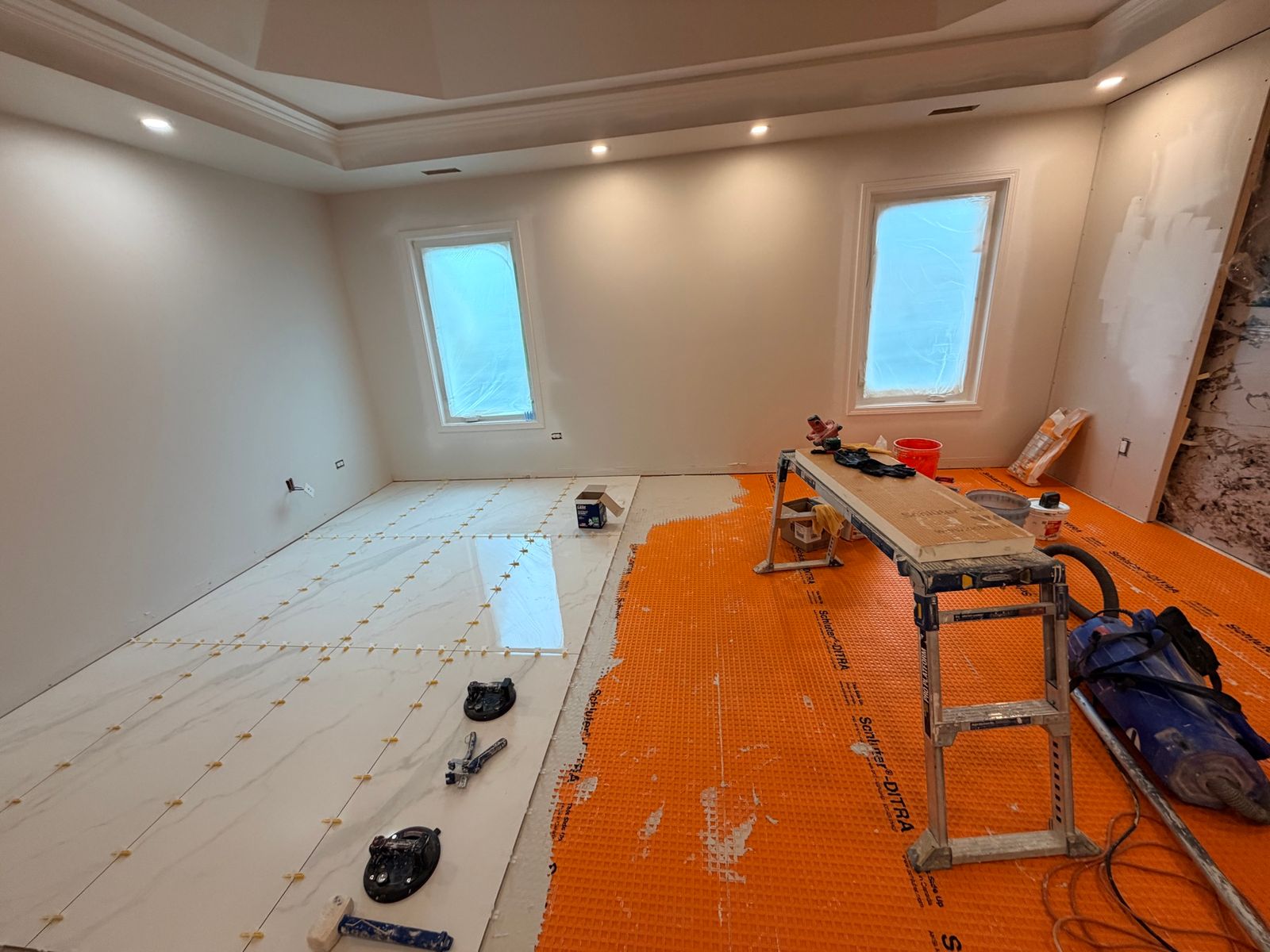
An uncoupling membrane is a thin sheet, often with a grid of small cavities, laid between the subfloor and the tile. It is set in mortar, and the tile is set on top. Its job is to separate the tile from small movements in the floor below, so that a hairline crack in a slab or the shifting of boards does not travel up into the tile.
In a bedroom we worked on, one photo shows the job half done: marble-look tile laid on one side of the room, and an orange membrane ready for tile on the other. It is a good picture of the layers in action.
Layer four: the mortar
The mortar that holds the tile has to be the right type for the tile and the floor, mixed correctly and spread with the right trowel. Large tiles need full coverage, with no hollow patches under them. We check this by lifting a tile now and then during the installation and looking at the back.
Layer five: the tile and the joints
With large tile, the layout is planned before the first piece goes down, so cuts land where they look intentional. Spacers and leveling clips keep neighboring edges at the same height. The joints are narrow, and the grout is chosen to blend with the tile or to define it, depending on the look you want.
Movement joints
Large floors need places where the tile is allowed to move slightly, such as at walls, at changes of direction and across big open areas. These are filled with a flexible material instead of rigid grout. They are easy to forget and important to include.
Heat under the tile
Porcelain can feel cold on bare feet in winter. Electric heating mats or cables can be placed under the tile, usually with the membrane. Planning heat early means planning thermostats and electrical connections before the floor goes in.
What goes wrong when layers are skipped
- **Cracked tile** from a flexing floor or a hollow patch
- **Lippage**, where neighboring edges sit at different heights
- **Loose or hollow-sounding tiles** that were not fully bedded
- **Cracked grout** where movement was not allowed for
None of these shows on the first day. They appear later, when fixing them means lifting the floor.
Permits and conditions
Tile is rarely a permit item by itself, but changes to the structure or other trades may be. Requirements vary by village, so check with your village building department. We tell you what applies when we visit.
Talk it through with us
If you are planning a tile floor, we would like to show you what we put underneath it. See our flooring and tile page, then request a free estimate and we will check your subfloor.
Questions people ask
Do I need a membrane under every tile floor?
Not every floor, but it is a good idea for large tile, especially over wood subfloors. We recommend it after looking at your floor.
Can new tile go over old tile?
Sometimes, if the old floor is flat and solid. We check the surface and tell you whether removing it is the better choice.
Will heated floors work with large tile?
Yes. The heating is planned with the membrane and the electrical work before the tile goes down.