Bathrooms · · 4 min read
Large-format porcelain tile in bathrooms: why it looks better and what installation demands
Big tiles mean fewer lines and a calmer room. They also leave very little room for error.
Walk into a bathroom finished in large porcelain tile and the first thing you notice is how quiet it looks. The walls read as one calm surface instead of a grid of small squares. That effect is the reason large-format tile has become a favorite in the bathrooms we build.
It is also unforgiving. A big tile shows every bump in the wall behind it, so the quality of the installation matters more than the price of the tile.
What counts as large format
There is no strict rule, but in practice it means tiles that are much bigger than the familiar square you might remember from older bathrooms. They are often long rectangles or big squares, and some are thin porcelain panels that cover a wall with only a few joints.
Porcelain is the material of choice. It is dense, resists moisture and does not need regular sealing in the way some natural stone does. It can be made to look like marble, concrete, wood or stone, which is how a bathroom can have the look of a gray concrete wall or a veined marble floor without the upkeep.
Why it looks better
Fewer joints mean fewer lines for the eye to follow. In a small bathroom that makes the room feel larger. In a large one it gives the walls a clean, architectural look.
It also helps with cleaning. Grout is the part of a tiled surface that collects soap and stains. With big tiles there is simply less of it.
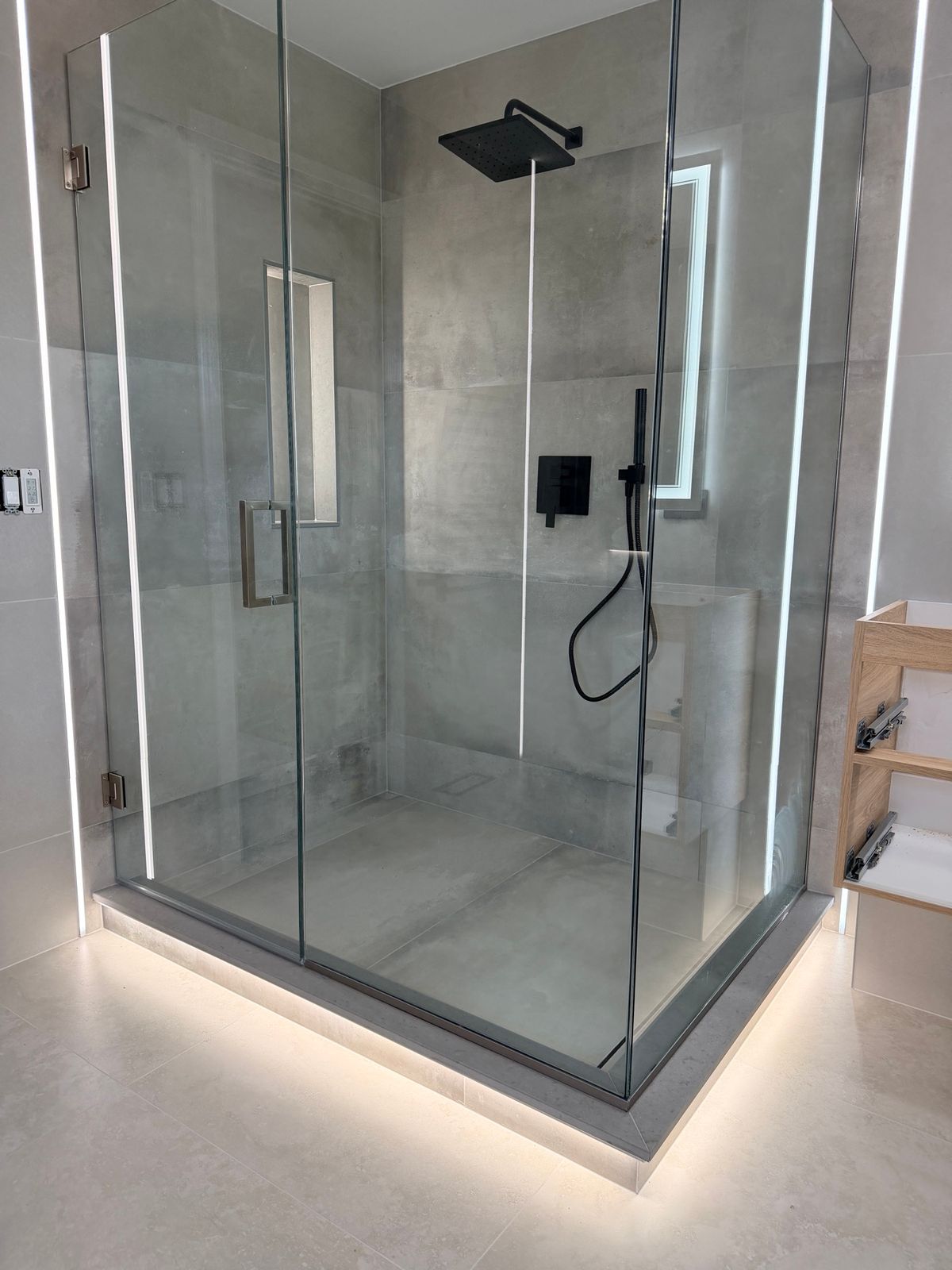
You can see the effect in a spa-style bathroom we finished in warm gray porcelain, where the same large tile runs across the walls and floor of the shower area and the rest of the room. Another primary bath uses dark onyx-look porcelain with gold veining on the wall behind the vanity and across the floor.
What the installation demands
Large tile is only as flat as what it is laid on. Here is what a careful installer does differently.
- **Flatten the surface.** Walls and floors are checked with a long straightedge, and low or high spots are corrected before any tile goes up.
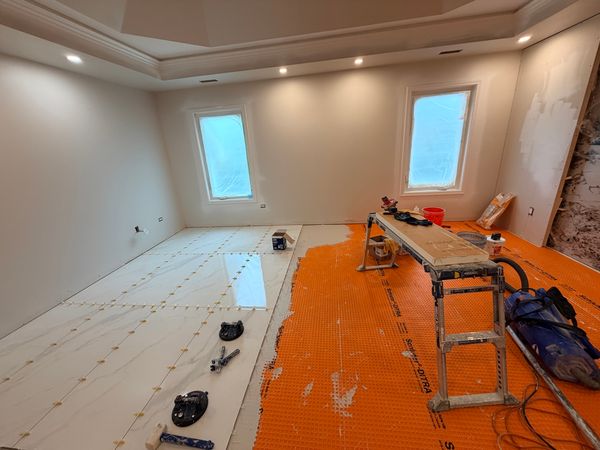
- **Use the right setting material.** Heavy tiles need a thick-bed or large-tile mortar and full coverage on the back of each piece, so there are no hollow spots.
- **Plan the layout first.** The tiles are laid out dry so cuts fall in sensible places, and the pattern lines up with the shower niche, the vanity and the door.
- **Use leveling clips.** Small spacers keep neighboring tiles at the same height, so edges do not catch a bare foot.
- **Handle with care.** Big pieces are heavy and can crack if they flex. Two people and suction handles are standard.
The layers behind the tile
In a shower, what you cannot see is more important than what you can. The walls and floor need a waterproofing layer, and the floor needs a slope toward the drain. We keep these steps separate from the tile work and check each one before moving on.
On floors, an uncoupling membrane between the subfloor and the tile helps protect a large tile from cracks if the structure moves slightly with the seasons. We write more about that in our post on why the layers under floor tile matter.
Where large tile is not the answer
Large tile is not right for every room. A very small floor with a drain that slopes in several directions is easier to tile with smaller pieces, because big tiles cannot follow the slope. Curved surfaces and unusual shapes also call for smaller formats.
If you are not sure, ask for a sample and look at it in your own light. Colors change a lot between a showroom and a bathroom with a window.
Cost and timing
Large tile is not automatically more or less expensive. What drives cost is the tile itself, the amount of preparation the walls and floor need, the pattern, the number of cuts and the work around niches and corners. We explain each of these in the estimate.
Talk it through with us
If you are weighing tile choices for a bathroom, start with our bathroom remodeling page, then request a free estimate. We will bring samples, look at the walls and tell you plainly what the room needs.
Questions people ask
Is large-format tile slippery on a shower floor?
Surface finish matters more than size. We choose a floor tile with a texture suited to a wet area and talk through the options with you.
Can large tile go over my existing tile?
Sometimes, but the surface has to be flat and sound. We usually remove old tile in wet areas so we can check and waterproof what is underneath.
Does large tile crack more easily?
It can if it is laid on an uneven or flexing surface. Good preparation and an uncoupling membrane on floors are what protect it.