Floors and finishing · · 4 min read
Accent walls that feel built-in: wood slats, slab tile and paneling
A good accent wall looks like it was always part of the house. The planning is what makes that happen.
Accent walls have a reputation for being a single stripe of bold paint. A better version is one that is built into the room: a wall of wood slats behind a TV, a slab of veined stone-look tile beside a bed, a niche with a lit shelf. These are not afterthoughts. They are part of the structure.
Here is how to plan an accent wall that feels at home.
Choose the right wall
An accent wall works best when there is a reason for it. A wall that already draws the eye is a natural candidate: the wall behind a bed, a fireplace wall, the wall a TV hangs on or the wall you see first as you enter.
Avoid wrapping accents on several walls at once. One strong wall gives the room a focus and lets the others rest.
Wood slats
Vertical wood slats, spaced evenly, add warmth and texture. They also soften sound, which helps in a room with hard floors.
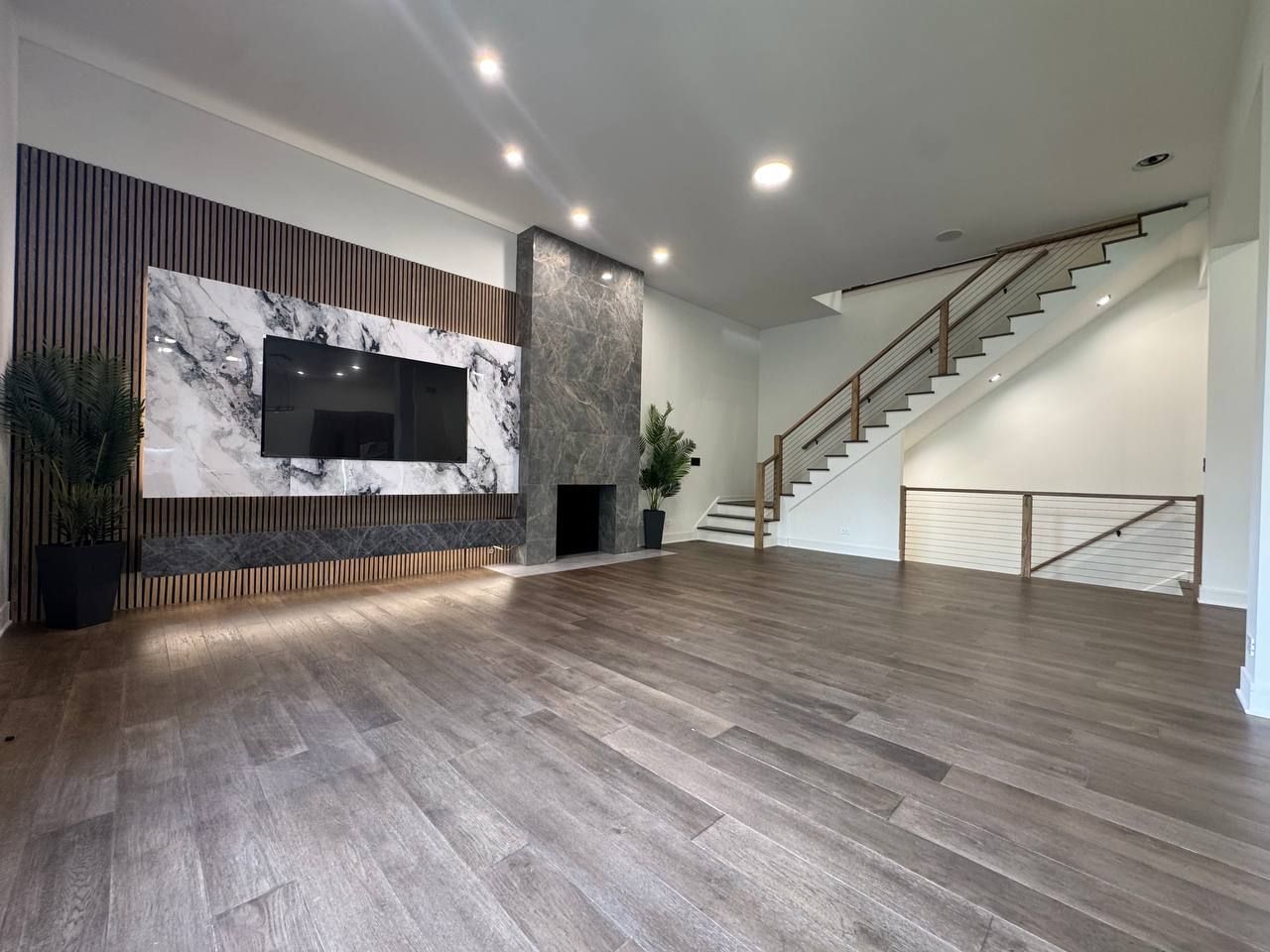
In a living room we finished, a wood slat wall holds a marble-look panel for the TV, beside a stone-look fireplace surround. The slats continue as the base of a coffee-bar niche on another wall, so the two features read as a set.
Things to plan:
- **Spacing and depth.** Wider gaps look lighter. Tight gaps look more solid.
- **Backing.** A dark backing behind the gaps makes the slats stand out. A light backing softens the look.
- **Finish.** The same species and stain across the project keeps things consistent.
- **Wiring.** Outlets, data and speaker wires for a TV must be planned before the slats go up.
Slab tile
Large porcelain slabs, with a veined or stone-like pattern, can cover a wall with very few joints. It looks like a single piece of stone, and the patterns can be matched from slab to slab, a technique called book-matching.
In a bedroom we finished, a veined slab-tile accent wall sits between dark wood slat panels, under a lit tray ceiling. The mix of stone-look and wood gives the room depth without clutter.
Things to plan:
- **Weight.** Slabs are heavy, so the wall has to be built to carry them.
- **Layout.** The pattern should land well around windows, outlets and corners.
- **Installation.** Large slabs need skilled handling. This is not a place to economize on the installer.
- **Lighting.** Light skimming the surface shows off the pattern, but it also shows flaws, so the wall has to be flat.
Paneling
Flat or shaped wall panels, from simple squares to shaker-style frames, add depth and character. Painted in a single color, they give a traditional room a polished feel.
Things to plan:
- **Proportions.** The panel sizes should relate to the height of the wall and the doors.
- **Trim.** Baseboards, rails and crown molding should line up with the panels.
- **Finish.** A durable paint, applied after the panels are filled and sanded, gives a clean result.
Make it look built-in
Several details make the difference between built-in and stuck-on.
- **Run the feature to the corners and the ceiling.** A wall that stops short looks like a panel.
- **Align with other lines.** Match the heights of doors, windows and niches.
- **Hide the practical parts.** Wires, outlets and access panels should be planned so they disappear.
- **Add a light.** A hidden strip along the top or bottom edge creates a glow at night.
Cost and timing
Cost depends on the material, the size of the wall, the preparation of the surface, the amount of cutting and the lighting and wiring. We explain these in the estimate.
Permits
Cosmetic wall finishes rarely need a permit, but changes to electrical work or walls may. Requirements vary by village, so check with your village building department.
Keep the rest of the room quiet
An accent wall works because the rest of the room is calm. If the other walls, the floor and the furniture are all competing for attention, the feature loses its effect. In the rooms we have finished, we usually keep the surrounding walls a soft, even color and let the floor be a single material. That restraint is what makes the accent look intentional. If you are unsure, start with one feature and live with it. Adding a second is easy later; removing a fully built one is not.
Talk it through with us
If you have a wall that needs a focal point, see our interior finishing page, then request a free estimate. We will help you choose the wall and the material.
Questions people ask
Do wood slats collect dust?
They can, like any textured surface. A soft brush or vacuum attachment keeps them clean.
Can slab tile go over an existing wall?
The wall has to be flat and strong enough. We check it and prepare it before the slab goes up.
Can I hide a TV and its wires in an accent wall?
Yes. Plan the wiring and any recess before the wall is finished.