Kitchens · · 4 min read
Choosing countertops: quartz, porcelain slab or natural stone
Every counter material is a trade-off. The best one is the one that fits how you actually cook.
The countertop is where a kitchen gets used hardest. It takes hot pans, spilled wine, knives, wet dishes and homework. It is also one of the first things people see. Choosing one is a mix of practical and visual decisions.
Here is how three popular options compare, in general terms. Individual products vary, so always ask the supplier for the care instructions of the exact material you are considering.
Quartz
Quartz counters are made from crushed stone bound with resin, then shaped into slabs. They come in a wide range of colors and patterns, including ones that look like marble.
**Good for:** Everyday use. The surface is non-porous, so it does not need sealing, and it resists most stains.
**Watch for:** Heat. Because it contains resin, a very hot pan set straight on the surface can leave a mark, so use a trivet. Some very dark or very light colors show smudges and fingerprints more.
Porcelain slab
Porcelain slab is a large, thin sheet of the same dense material used for large floor and wall tile, with the color and pattern carried through the surface. Slabs can look like marble, concrete or stone.
**Good for:** Heat and scratches. Porcelain resists heat well and does not stain easily, and because the color and pattern run through the surface, it looks consistent from slab to slab.
**Watch for:** The edges and corners. A thin slab can chip if something hard hits an edge, and the fabrication is specialized, so it matters who cuts and installs it. A fabricator experienced with porcelain is worth the trouble.
Natural stone
Granite, marble and other natural stones are cut from the earth, so no two slabs are the same. That is their charm. A veined slab can look like a piece of art.
**Good for:** Character. If you want a surface that is truly one of a kind, stone delivers it.
**Watch for:** Care. Many natural stones are porous and need to be sealed from time to time. Marble in particular can etch from acidic things like lemon juice or wine, leaving dull marks. Some people love how marble ages, and others find it frustrating. Be honest with yourself about which you are.
A quick comparison
- **Easiest to live with:** quartz
- **Best against heat:** porcelain slab
- **Most individual look:** natural stone
- **Most care needed:** natural stone, especially marble
- **Most specialized to install:** porcelain slab
Think beyond the material
Several other choices shape how a counter looks and works.
- **Edge.** A clean, square edge looks modern. A rounded edge is softer and more forgiving.
- **Thickness and build-up.** A thick or mitered edge makes an island look heavy and bold.
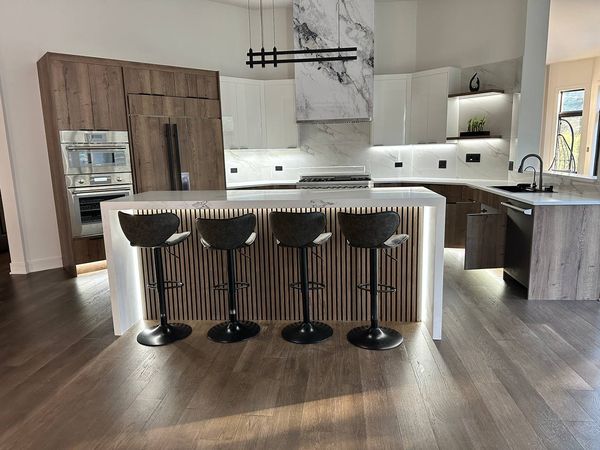
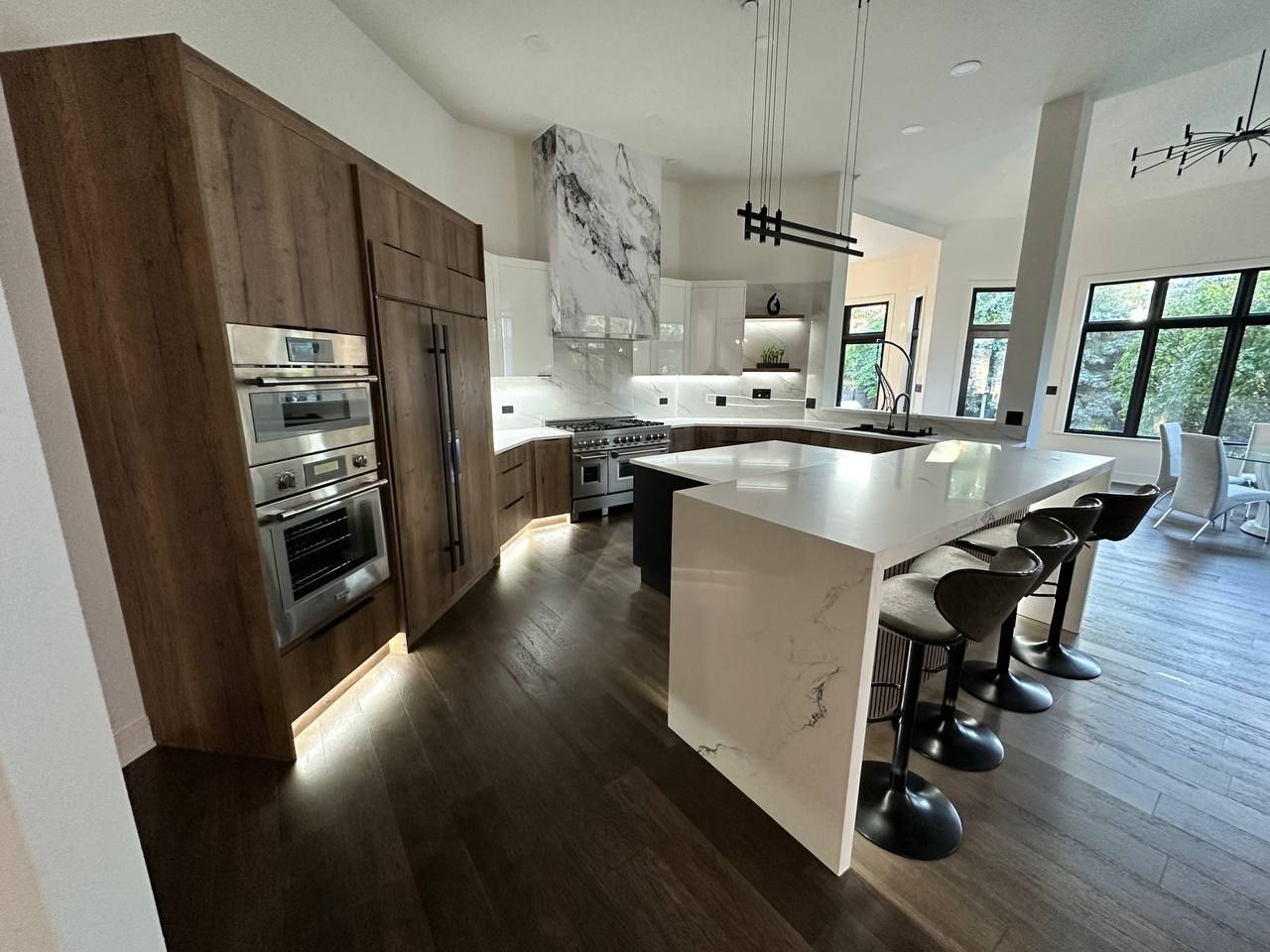
- **Waterfall sides.** On an island, the counter can continue down the sides to the floor. It looks striking and protects the cabinet ends. In a modern kitchen we finished, a white waterfall island with a wood slat-panel base is the center of the room.
- **Seams.** Long runs need joints. A good fabricator places them where they are least visible.
- **Backsplash.** A full-height slab backsplash looks seamless, but it is a bigger decision than a row of tile.
See the slab, not the sample
A small sample hides the pattern. For stone and for patterned quartz or porcelain, ask to see the full slab before it is cut. Look at it in daylight and under the kitchen lights.
Cost and timing
Cost depends on the material, the thickness, the edge, the number of cutouts for sinks and cooktops, and the work of templating and installing. Counters are usually made after the cabinets are in place, so allow time between the two steps.
Ask how the counter will be installed
The best material can be let down by a poor installation. Ask who will measure the counters, who will fabricate them and who will set them. The measurements should be taken after the cabinets are in, because even a small difference matters on a long run. Ask where the seams will fall and whether the pattern will line up across them. Ask how the cutouts for the sink and the cooktop are made, and how the edges are finished. These questions are quick to ask and will tell you a lot about whether the work will look as good as the sample.
Talk it through with us
If you are comparing materials, our team can bring samples to your kitchen. Start from our kitchen remodeling page and request a free estimate; we will help you narrow the choices.
Questions people ask
Is quartz or granite better?
Neither is better for everyone. Quartz asks for less care, while granite offers natural variation. We help you compare based on how you use the kitchen.
Can I put a hot pan on a porcelain counter?
Porcelain handles heat better than most counter materials, but we still suggest following the maker's instructions.
Do natural stone counters need sealing?
Many do. The need depends on the stone, so ask for the care instructions for the slab you choose.